Classic SEO
Google should find your site, crawl it and show it in the search results.
- Keywords
- Meta titles
- Loading speed
- Backlinks
- Content
Solutions
It will also need to be understood by ChatGPT, Gemini, Claude, Grok, Perplexity, Siri and other AI systems.
Search is changing right now. More and more people are putting their questions directly to AI systems. These systems read websites, compare sources and give answers — often without the user clicking through ten websites any more. If your site isn't clearly understandable, structured and trustworthy, you lose visibility. Not someday. Step by step, starting now.
No theory. I'm already building structures like this live — in client projects and measured on my own system.
The basics
It used to be mainly about ranking as high as possible on Google. Today there's a new layer: AI systems answer questions directly. To do that, they look for sources they can understand, classify and trust.
Classic SEO
Google should find your site, crawl it and show it in the search results.
AI SEO
AI systems should understand who you are, what you offer, which content matters and why your site is a trustworthy source.
The difference
On Google, you fight for clicks in a list. With AI systems, you fight to appear as a source in the answer at all.
Put simply
AI SEO means building your website so that not only people understand it, but machines too. That takes clear content, clean technology, structured data, well-defined topic areas and signals that build trust.
Market shift
Many businesses still think: when someone is looking for something, they go to Google, see ten results and then click on a website.
But more and more often, it works differently.
The user asks an AI. The AI reads several sources, summarises the answer and, at best, names individual websites as sources. The classic click can disappear in the process — or only go to the sites recognised as particularly helpful and trustworthy.
If you don't appear in AI answers, you can be visible and still become invisible.
My core offer
An honest analysis and a concrete roadmap for making your website easier to understand for Google, AI systems and real visitors.
I don't just look at how your website looks. I check whether it's strong enough for the new digital reality:
Is it immediately clear what you offer? Does Google recognise your most important topics? Can AI systems classify your content properly? Are there trust signals? Is there structured data? Are clear answers to important questions missing? Does your expertise come across?
What does a visitor see? What does Google see? What does an AI see? And where does important information get lost?
I check page layout, navigation, content, topic logic, internal linking and technical readability.
I show you which content, data and structures should be added so that AI systems can understand your site better.
You get concrete next steps, not abstract advice: what should change, why it matters and what it does for your business?
Not every website needs everything. But every website should know what it's missing.
Big Picture
Design matters. But design alone is no longer enough. A good website brings together strategy, technology, content, data and automation.
Visitors need to understand immediately what you offer, who it's for and why they should trust you.
Fast loading times, a clear page structure, solid implementation and no unnecessary technical baggage.
No interchangeable agency copy, but clear content that answers questions and builds trust.
Structured data, clear topics, well-defined entities and content that AI systems can meaningfully evaluate.
Forms, data, emails, reports, analyses or workflows can be automated and supported by AI.
A good digital solution can grow: with new features, data sources, AI modules or internal tools.
Solution 1
I build websites for businesses, self-employed professionals and digital projects that want to come across as clear, fast and trustworthy.
It's not about filling some theme with pretty content. It's about explaining what you do clearly, guiding visitors, building trust and creating the technical foundation for visibility.
A website shouldn't just be online. It should work for you.
See the website solutionSolution 2
When people think of AI, many think of text or chatbots first. That's only a small part of it. Used properly, AI can analyse data, sort information, evaluate documents, prepare answers, speed up internal processes or take over routine tasks.
The goal isn't to replace people with gimmicks. The goal is to reduce repetitive work and make better decisions possible faster.
Solution 3
Not every business needs its own software. But sometimes standard solutions simply aren't enough.
Then a custom digital system can make sense: a dashboard, a customer area, an internal tool, an automated report, a database or an application that fits exactly how you work.
Sometimes the best solution isn't yet another tool, but a system built precisely for your process.
Plan a custom systemDisplay data clearly, analyse it and make it understandable.
Protected areas for customers, projects, content or documents.
Capture information cleanly, structure it and make it reusable.
Connect tools, retrieve data, analyse it or process it further automatically.
Solution 4
AI SEO isn't a replacement for classic SEO. It's the next layer on top of it.
I help you build your website so that its content becomes clearer, more structured and more machine-readable. That increases the chances of search engines and AI systems classifying your site better.
What I check and implement
An honest limitation
Nobody can guarantee that ChatGPT, Gemini or Grok will cite a particular website. But you can significantly improve the odds by building the site so that it's recognisable as a clear, helpful and trustworthy source.
Case Study
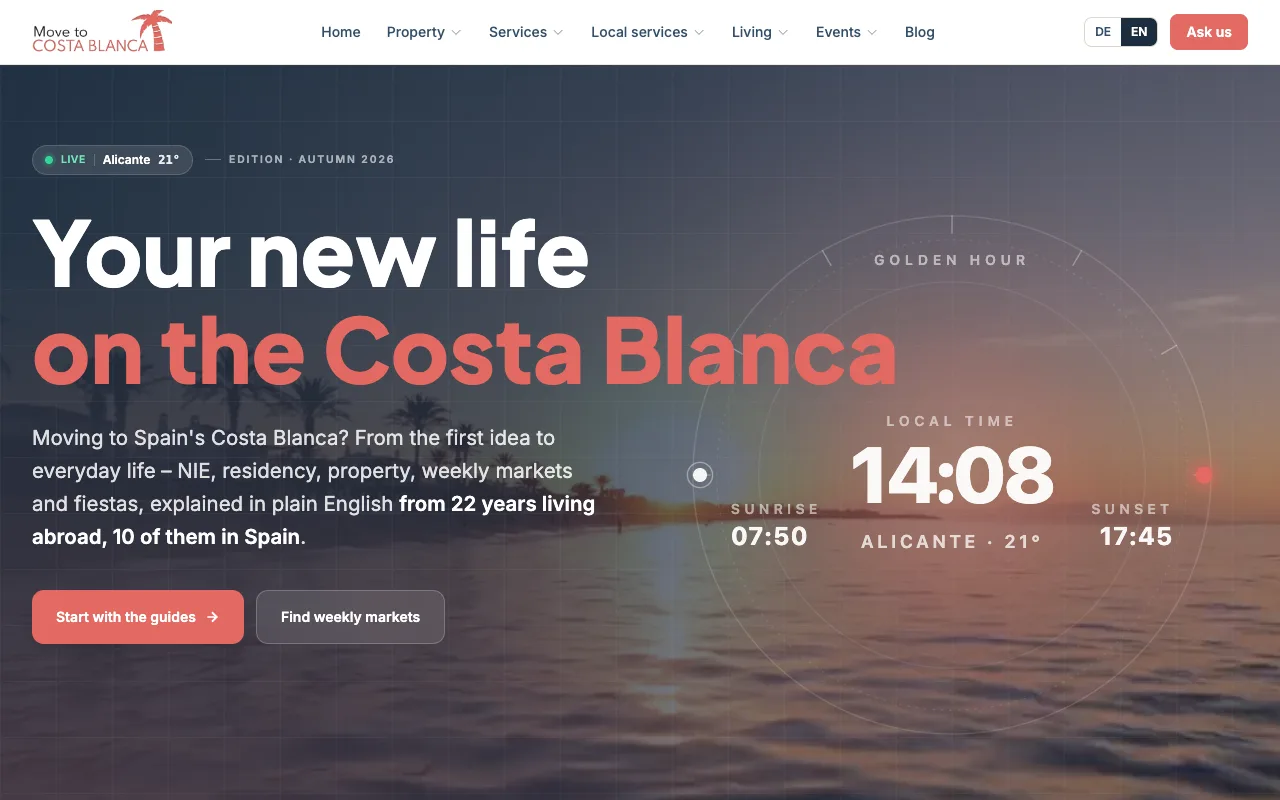
With move-to-costablanca.com, I'm building a local information portal for expats on the Costa Blanca.
The project isn't just a classic website with blog articles. It's built as a structured knowledge source — with local data, weekly markets, a business directory, guide pages, machine-readable AI endpoints, llms.txt, Schema.org, voice summaries and monitoring for AI crawlers.
The goal isn't just to be found on Google. The goal is for AI systems to understand which topics the site covers, what data is available and why the source is trustworthy.
View the projectWorking together
We clarify what it's about: website, AI, automation, visibility or a custom system.
I tell you clearly what makes sense, what would be overkill and where the biggest lever is.
You get a clear structure: what will be built, why it's being built and what it should achieve.
I implement the solution technically — with clear communication and no unnecessary agency loops.
Once the system is in place, it can be expanded: more content, automation, data sources, AI features or new sections.
Is it a fit?
Next step
I can show you what your site already does well today, what is missing and which steps would make sense so that people, search engines and AI systems understand your offer better.